SF2026-098
The way an AI approaches a question.
A method for helping AI models answer more reliably by examining the question and the evidence before answering. OrthoSystem puts that work into a platform for medical education.
The scalpel is one of the oldest tools in surgery. Its form hasn't fundamentally changed in centuries. Yet in the hands of a master surgeon versus a first-year resident, the outcomes are very different.
Artificial intelligence is the same kind of tool. The technology exists. What matters is how it's wielded, and by whom.
Powerful tools require judgment: questioning their answers, checking the evidence, and understanding their limits.
01 / Watch & read
The year in retrospect, the system in action, and the ideas behind it.
02 / OrthoSystem today
A connected workspace for medical education: search a reference library, ask questions with source citations, explore the library visually, and practise with OrthoTutor.
The starting point is the material we teach from. The goal is to help learners work with it: finding a useful source, understanding how ideas connect, and thinking through an explanation.
OrthoTutor and resident exam-preparation tools are now part of the work. A study tool for UCSF orthopaedic residents was deployed internally in October 2026.
03 / The inventions
How can AI answer more reliably? And how can we build with it more responsibly?
A method for helping AI models answer more reliably by examining the question and the evidence before answering. OrthoSystem puts that work into a platform for medical education.
A framework for building software with AI under formal design controls: connecting user needs, risks, requirements and verification, and keeping a record of what changed and why.
04 / The journey
My path here runs from graphics hardware journalism in the late 1990s, through the early days of GPU computing, to academic spine surgery and teaching residents at UCSF.
In summer 2025, those two careers met in a new question: what could I build if I brought the same teaching instincts to AI?
The full year-one storyWriting a review of AI for fellow surgeons, I recognized reasoning errors familiar from teaching early learners.
The DGX Spark arrived. The vision of a private medical library could fit on one machine.
A private reference library answered from trusted textbooks, fully offline.
User needs, requirements, risks and tests became part of the record. Changes needed a reason, and results needed evidence.
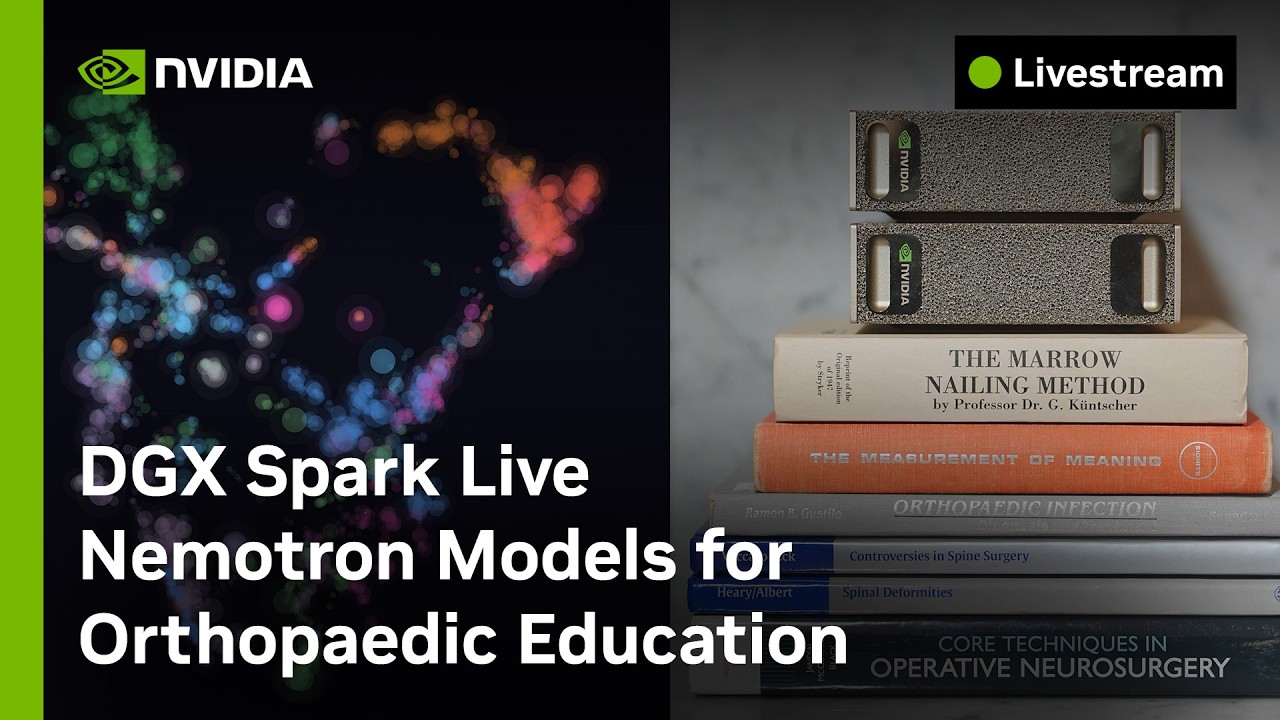
OrthoSystem answered orthopaedic questions on the DGX Spark broadcast.
Testing on the running machines found what code review had missed. OrthoTutor came to life with practice, topic briefings and explanations.
The work was evaluated against public research benchmarks, with results and limitations documented.
A study tool for UCSF orthopaedic residents was deployed internally. The next frontier is proving the tools with real learners.
05 / How it's built
Building with AI also means keeping track of what it builds: the decisions, the changes, the tests, and what still needs to be demonstrated.
Year-one snapshot, as recorded in the film's end cards. These describe the scale of the work, not its effectiveness.
Research, with context
The public NOHARM chart reports 82.8% severity-weighted F1 for a 30B-class open-weight model using the UCSF method, evaluated on the V2 open set. The chart keeps the comparison data and qualifications together.
Benchmark performance does not establish benefit in practice. Evaluation settings differ, and a study tool's effect on learning is a separate question.
More benchmark work in the Atelier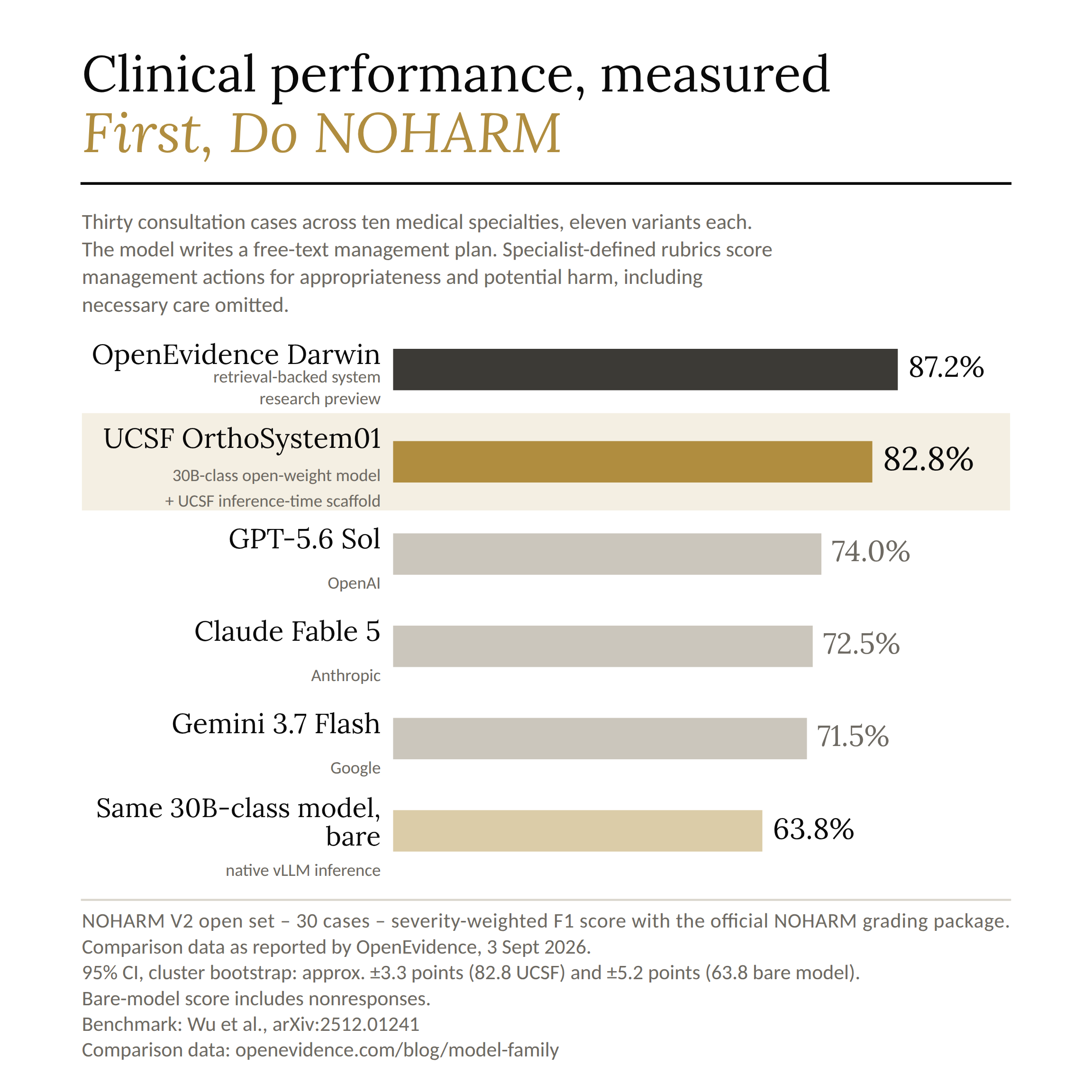
These are tools for education and research. Internal use, a documented development process and benchmark results are different kinds of evidence; none establishes improved learner outcomes, clinical benefit or regulatory clearance. Formal design controls describe how the software is developed. Evaluation with real learners remains work to do.
06 / The builder
Health Sciences Clinical Professor of Orthopaedic Surgery, UCSF. Staff Surgeon, San Francisco VA Health Center. Former GPU hardware reviewer, Thresh's FiringSquad and Tom's Hardware. Chief Medical Officer, Ortemiz.
Building OrthoSystem on nights and weekends.
07 / The workshop
Same deep dives, different decade and different stakes.
OrthoSystem's Atelier documents the construction process: the problems encountered, the solutions discovered, and the tools built along the way.
Enter the Atelier